
A room can be well-designed, thoughtfully furnished, and visually appealing—and still feel unsettled.
This is one of the most common frustrations in a home. Everything appears to be in place, yet something quietly resists comfort. The space never fully lands.
This isn’t a failure of taste.
It’s a failure of alignment.
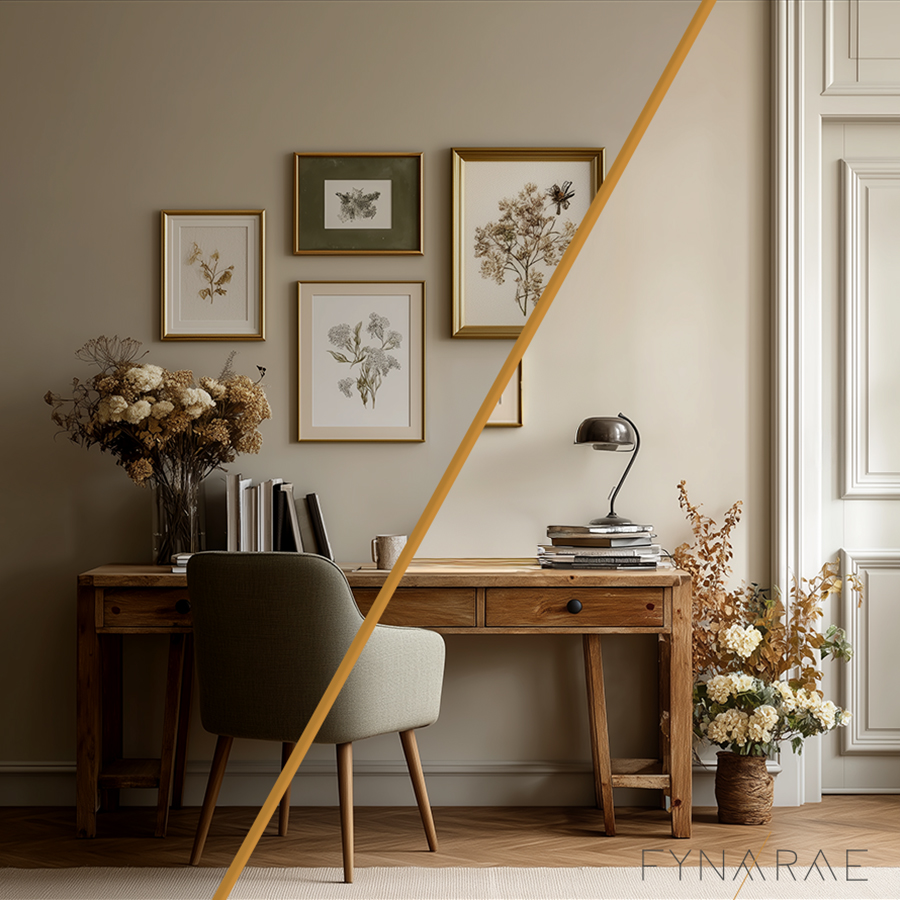
The Problem Isn’t What You Chose
Most people assume the issue is:
- the wrong artwork
- the wrong color palette
- or the need for something new
So they add, adjust, replace.
But often, the problem isn’t what’s there.
It’s how what’s there is behaving within the space.
Cohesion
This often comes from a mismatch in Cohesion—when elements carry different visual or emotional signals and fail to resolve as a whole.
An artwork can be beautiful on its own, but if it carries a different emotional weight than the space it occupies, it creates subtle tension.
This tension isn’t always obvious.
It doesn’t announce itself.
But it prevents the room from feeling settled.
The Absence of a Clear Focal Point
Some rooms lack a clear Focal Priority—nothing establishes a dominant point of attention or stability.
Without it, the space has no center.
Instead, everything exists at the same level:
- multiple pieces competing
- no clear center
- no sense of return
The result is a room that feels visually active, but unresolved.
When Visual Weight Is Misaligned
Even when a space includes strong pieces, the balance of Visual Weight may be off.
If everything demands attention, nothing can settle.
If nothing holds presence, the room can feel thin or temporary
A well-balanced space allows certain elements to carry quiet presence, while others recede.
The Role of Space Itself
Sometimes the issue isn’t the artwork at all.
It’s the lack of Spatial Hierarchy.
When pieces are too close together, or when every surface is activated, the room begins to feel compressed.
Even beautiful objects need room to exist.
When the Eye Can’t Rest
There is also the question of Visual Noise.
If every piece contains high detail, contrast, or complexity, the eye has nowhere to pause.
The room becomes mentally “loud,” even if the palette is soft.
Visual silence creates moments of rest—something essential for a space to feel calm.
The Shift
When a room feels off, the instinct is to change what’s visible.
But the real shift comes from understanding how each element contributes to the overall structure of the space.
- Reduce visual noise
- Establish focal priority
- Rebalance visual weight
- Clarify spatial hierarchy
A Different Way of Seeing
A space doesn’t feel right because everything is beautiful.
It feels right because everything is working together.
Once you begin to see this, the question changes.
Not:
“What should I add?”
But:
“What is this piece doing to the room?”
This article applies principles from the Fynarae Framework, including:
Focal Priority · Visual Weight · Spatial Hierarchy

0 Comments