
Spatial Hierarchy
Definition
Spatial Hierarchy is the ordering of elements within a space that directs the sequence of attention—what is seen first, what follows, and what recedes.
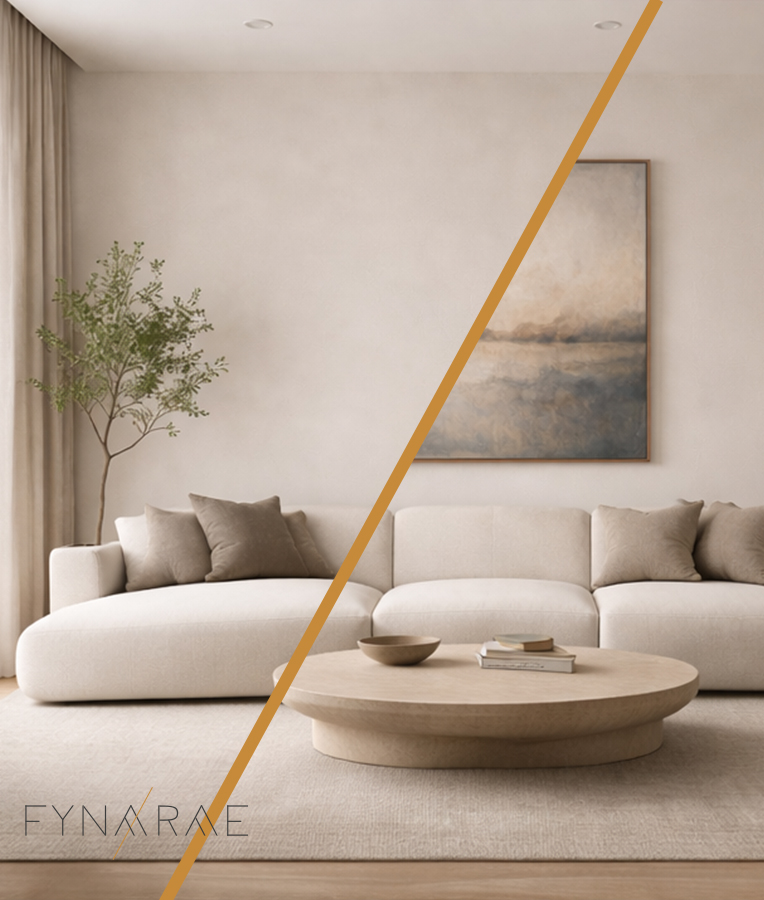
What creates it
- Relative placement (central vs peripheral)
- Spacing between elements
- Grouping and separation
- Alignment within the space
How it behaves
- Strong hierarchy = the eye moves naturally and predictably
- Weak hierarchy = the eye searches without direction
- No hierarchy = everything competes at the same level
Why it matters
Without Spatial Hierarchy, a space has no structure for attention.
The eye is forced to scan rather than follow.
This is what creates the feeling that something is “off,” even when the elements themselves are correct.
This concept explains why:
- Wall art doesn’t “land” properly
- Rearranging a space fixes it without adding anything
- Some spaces feel instantly clear, while others feel unresolved
This is not:
Visual Weight → which determines how heavy or dominant an element feels
Focal Priority → which determines what holds the most attention
Cohesion → which determines whether elements feel unified
Spatial Hierarchy does not decide what is important—
it determines how attention moves through what exists.
Related concepts:
Visual Weight
Focal Priority
Visual Noise
Articles that apply this concept:
You Don’t Need New Art—You Need Better Placement
The Hidden Reason Your Wall Art Isn’t Working
Why Most Gallery Walls Feel Chaotic (Even When They’re Balanced)
Why a Beautiful Room Still Feels Off
Why Your Room Feels Off (Even When It Looks Good)
Framework
This concept is part of the Fynarae Framework.