
Online spaces are designed to be seen.
Your home is meant to be lived in.
That difference creates a fundamental disconnect.
Images online are curated, edited, and stripped of context.
They are framed intentionally, lit artificially, and often simplified to highlight specific elements.
They remove critical variables:
- True scale
- Spatial relationships
- Emotional continuity across a room
So everything appears cohesive.
Until you try to recreate it.
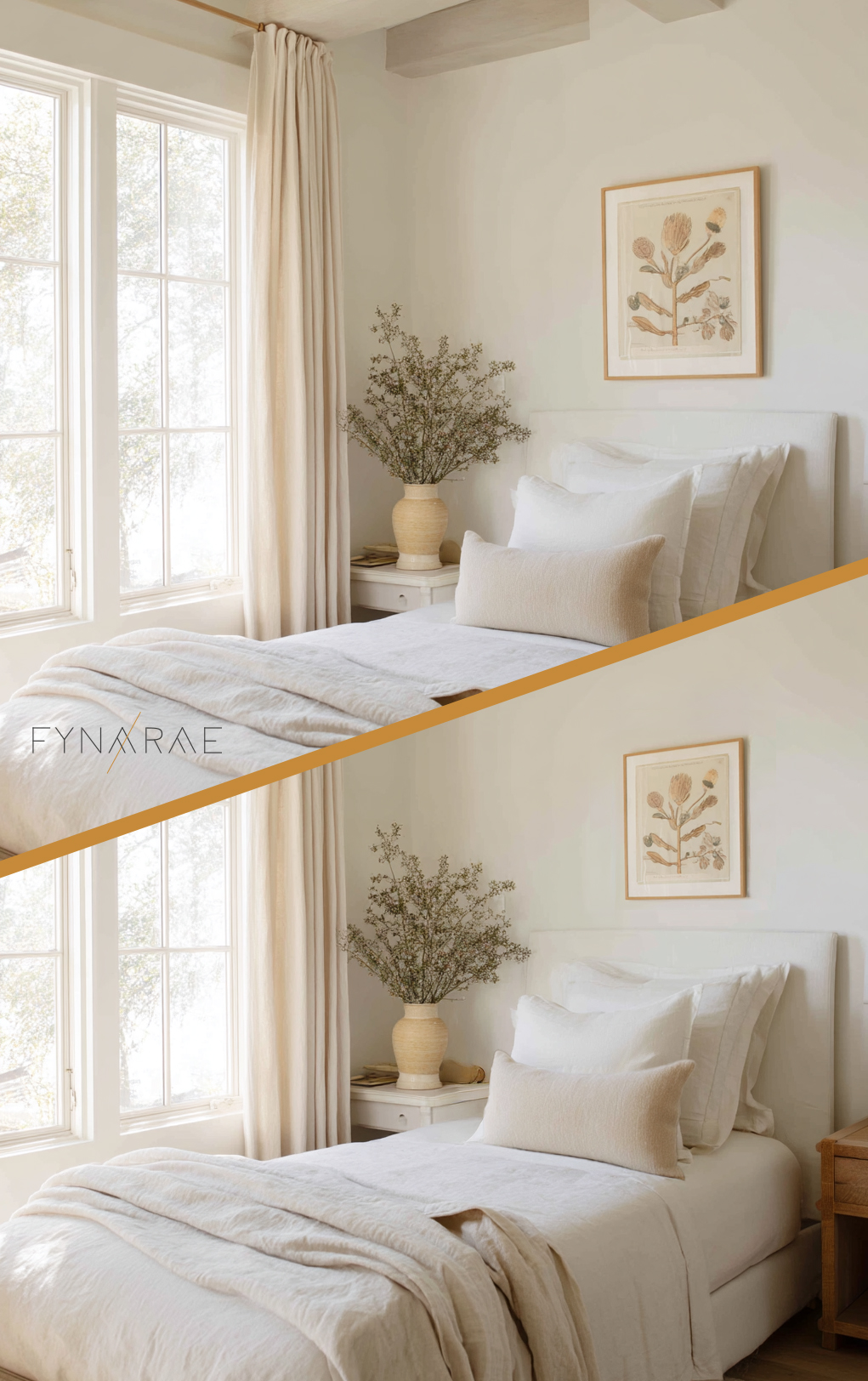
Then something shifts:
- The scale feels off
- The piece feels disconnected
- The room feels unresolved
This is not a failure of taste.
It is a mismatch between inspiration and reality.
Online images operate as fragments.
Your home operates as a system.
When you import isolated ideas without adapting them to your environment, they lose coherence.
This is why rooms built from inspiration alone often feel disjointed—even when every individual element is “good.”
Images are not the issue.
Interpretation is.
What’s Actually Breaking
When something looks good online but fails in your home, it’s usually not one issue.
It’s a breakdown across multiple structural factors:
Light as Structure
Online images are lit intentionally.
Your home is not.
Light changes what is visible, what recedes, and what carries presence.
Visual Weight
A piece that feels balanced in a photo may become too heavy—or too weak—when placed in your space.
Focal Priority
Images are composed around a clear focal point.
In a real room, that priority often disappears or competes with other elements.
Spatial Hierarchy
Photos flatten relationships.
In reality, spacing and placement determine how the eye moves through the room.
Cohesion
Online images remove context.
Your space contains it.
What worked in isolation may not resolve with what already exists.
Visual Noise
A single styled image feels controlled.
A real space contains accumulation.
Without control, that becomes interference.
The Shift
The goal is not to recreate what you see.
It is to understand what is happening—and rebuild it within your own space.
What works in your home is not what looks good in isolation. It’s what holds together in context.
FYNARAE is not inspiration.
It is a filter.
It helps you translate what you see into something that actually works where you live.
This article applies principles from the Fynarae Framework, including:
Focal Priority · Light As Structure · Visual Weight

0 Comments