
Visual Noise
Definition
Visual Noise is the level of competing visual signals within a space that disrupts the ability for attention to settle.
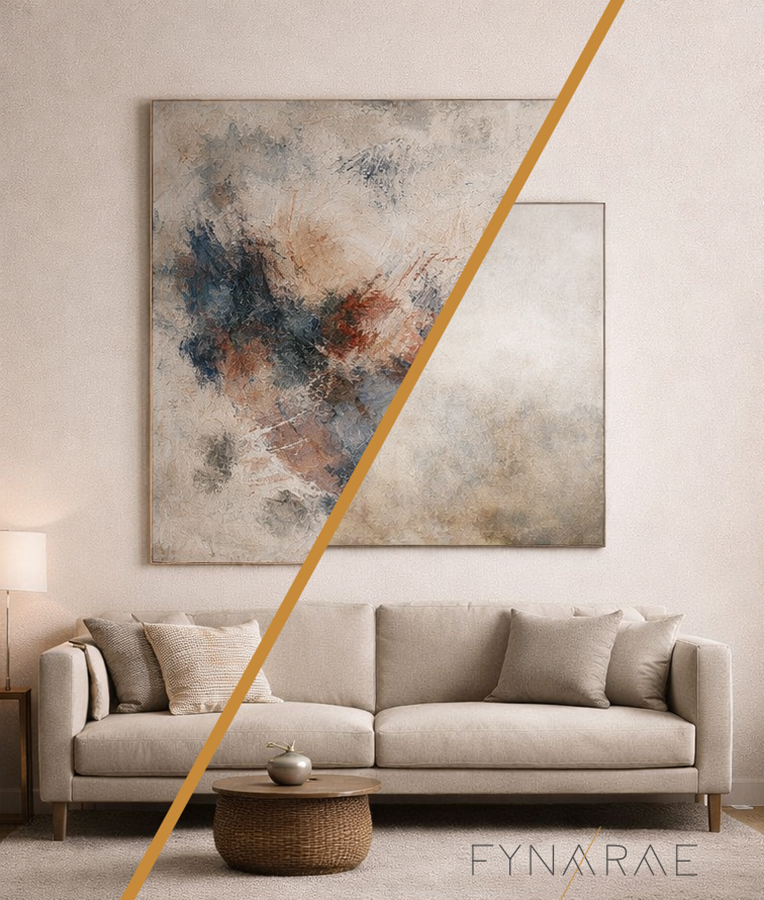
What creates it
- Too many elements within the same visual field
- Multiple competing focal points
- Repetition of high contrast or detail
- Lack of clear spatial hierarchy
- Inconsistent relationships in scale or style
How it behaves
- Noise fragments attention
- The eye scans instead of settling
- Increased noise increases cognitive load
- The space feels active, even when nothing is moving
Why it matters
A space can be minimal, clean, and well-composed—
and still feel chaotic if visual noise is high.
Clarity is not created by removing elements alone.
It is created by reducing competition between them.
This concept explains why:
- A room feels busy even when it is tidy
- Gallery walls feel chaotic despite being balanced
- “Something feels wrong” without an obvious cause
This is not:
Spatial Hierarchy → which determines the order in which elements are seen
Focal Priority → which determines what dominates attention
Visual Weight → which determines how strongly elements pull attention
Visual Noise does not define order, importance, or strength—
it defines how much interference exists between elements.
Related concepts:
Spatial Hierarchy
Focal Priority
Visual Weight
Articles that apply this concept:
Why Some Rooms Feel Visually Noisy (Even When They’re Clean)
Why Adding More Doesn’t Fix a Space
When Cozy Starts to Feel Overwhelming
Why Most Gallery Walls Feel Chaotic (Even When They’re Balanced)
Framework
This concept is part of the Fynarae Framework.