
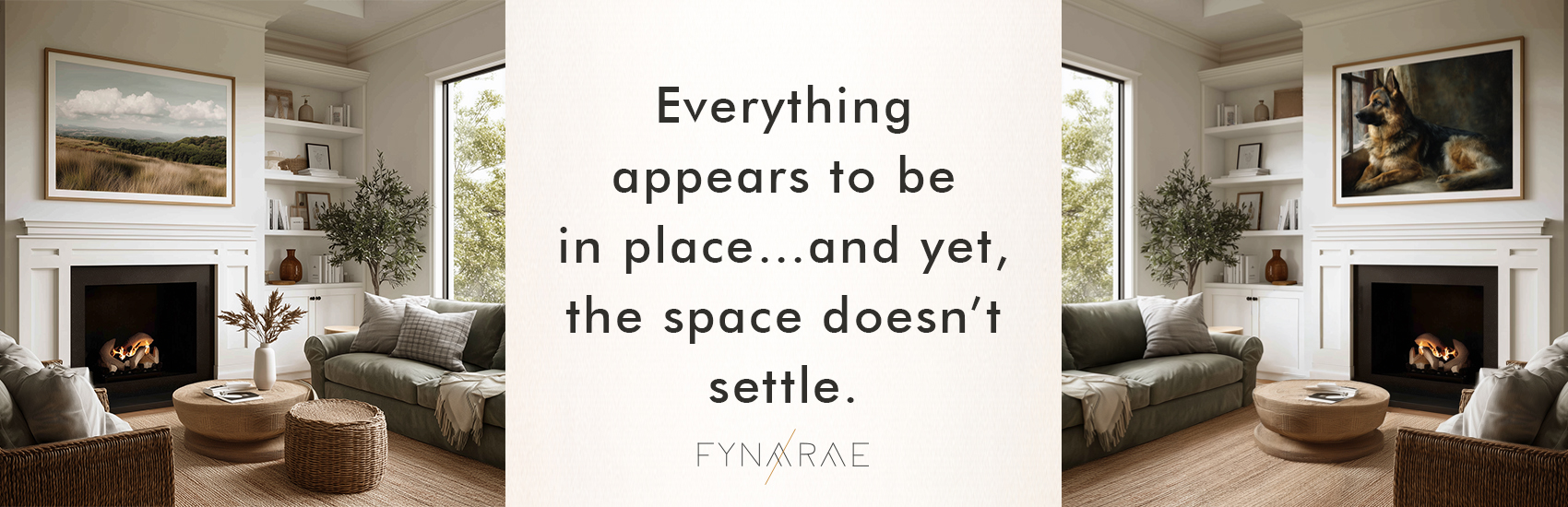
Most spaces that are considered “well-designed” have something in common.
They follow the rules.
They use the right colors.
They include the right pieces.
And yet, many of them still feel incomplete.
The issue is not a lack of effort or taste — it’s a misunderstanding of what good design actually requires.
Good design is often treated as a visual exercise. A matter of choosing the right objects and arranging them correctly. But a space is not experienced as a collection of things. It is experienced as a whole.
When that whole is not clearly defined, the result is a space that looks right but doesn’t feel right.
This is where intentional design becomes essential.
Intentional design is not about perfection. It’s about direction. Every choice in a space should support a specific feeling — whether that feeling is calm, warmth, clarity, or something else entirely. Without that underlying intention, decisions become reactive. Pieces are added because they “fit,” not because they contribute.
Over time, this leads to a kind of quiet inconsistency.
That inconsistency shows up in what can be described as a lack of environmental tone. The space has no clear emotional atmosphere. It may be pleasant, but it isn’t defined. Nothing ties the elements together beyond surface compatibility.
And when a space lacks a clear tone, it also lacks a center.
Every space needs what can be understood as an emotional anchor — a point of focus that stabilizes the entire room. This doesn’t have to be bold or dramatic. In many cases, it’s subtle. But it provides a sense of orientation. It tells the eye where to land and the space where to settle.
Without an emotional anchor, a room can feel scattered, even when everything in it is technically correct.
This is where most spaces fall short.
They prioritize appearance over experience. They follow visible rules while overlooking invisible structure.
Good design is not just about what is placed in a space.
It is about what that space is meant to hold — and whether every element supports that purpose.
When it does, the difference is immediate.
Not because the space looks better, but because it finally feels complete.
This article applies principles from the Fynarae Framework, including:
Focal Priority · Visual Noise · Spatial Hierarchy

0 Comments